Card essay · Brainstorm
Brainstorm in Premodern: shuffling, sequencing, and why it is not a cantrip
What it does
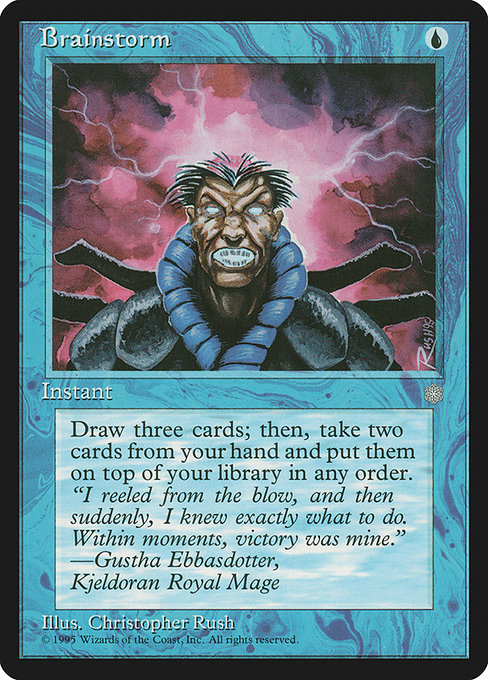
Brainstorm draws three cards, then puts two cards from your hand on top of your library. For one blue mana at instant speed. That sounds like a net zero — three drawn, two returned — and in Legacy, players have written thousands of words about how Brainstorm is actually a format-defining broken card. In Premodern, the calculus is similar but the tools that unlock Brainstorm’s full potential are different. Without free fetchlands, Brainstorm cannot reliably shuffle away its “bad” two cards. This makes Brainstorm in Premodern a card that rewards setup, sequencing skill, and timing discipline rather than raw power from the first draw.
When it’s played
Brainstorm appears in blue control and tempo archetypes across Premodern.
- Psychatog runs four copies as the primary card selection engine — it finds Counterspell, filters dead cards in the late game, and sets up the kill-turn by stacking the perfect five-card hand.
- Landstill uses Brainstorm during the opponent’s end step to sculpt the hand while Standstill sits on the battlefield.
- Mono-Blue Control runs it alongside Sleight of Hand for a full suite of filtering.
- Threshold decks use it to fuel graveyard depth toward the Threshold condition while finding threat or permission as needed.
- Doomsday uses Brainstorm to draw into the pile it creates with the namesake sorcery.
The math / interaction worth knowing
Brainstorm without a shuffle is often a trap. Putting two bad cards on top of your library means you will draw them in the next two turns unless you can shuffle. In Legacy, Flooded Strand and Polluted Delta immediately shuffle away those cards. In Premodern, the shuffle sources are: Mishra’s Factory (no help), Gemstone Mine (no help), or the occasional Orcish Librarian (too slow). The cleanest shuffle effect in Premodern blue decks is simply drawing your next card naturally. This means: never Brainstorm on your main phase in the early game unless you have a shuffle source. Brainstorm in response to an opponent’s spell, however, is frequently correct — you get the information, select your best two puts, and may have drawn a counter that was not on top.
Brainstorm at the end of your opponent’s turn changes the feel entirely. When you Brainstorm at instant speed on the end step, you’re essentially playing a version of the card with an eight-card hand on your draw step, minus two. In control mirrors, this lets you keep mana up for Counterspell or Memory Lapse on your opponent’s turn, then Brainstorm at their end step to reload for your turn. This is the correct pattern: protect the ability to counter first, then dig second.
Brainstorm “locks” your library for two turns. If you Brainstorm and put two cards on top, you know your next two draws exactly. You can play around opponent’s information accordingly — if one of the cards is a land you don’t need, you can plan your mana for two turns precisely. If it’s a key spell, you can protect it by not walking into Duress or Cabal Therapy.
Decklists worth studying
When deck data populates, look for Psychatog and Landstill lists from MTGO Premodern Challenges. Psychatog pilots frequently Brainstorm at end-of-turn, returning the two lowest-impact cards, then untap and immediately cast a threat or counter.
Related cards
- Counterspell — The format’s best hard counter; Brainstorm finds it on demand.
- Memory Lapse — The instant-speed tempo counter that combos best with end-of-turn Brainstorm sequences.
- Sleight of Hand — The complementary cantrip; see one card deeper, put the better one on top.
- Psychatog — The primary win condition in the Psychatog archetype that uses Brainstorm most extensively.
- Standstill — Brainstorm during a Standstill is one way to “break” it on your terms.
- Daze — Often found by Brainstorm in tempo builds; holds up against early threats.
- Force Spike — Like Daze, frequently the card you’re digging for with Brainstorm in the early turns.