Card essay · Cabal Therapy
Cabal Therapy in Premodern: the naming skill, the flashback engine, and why it pairs with sacrifice outlets
What it does
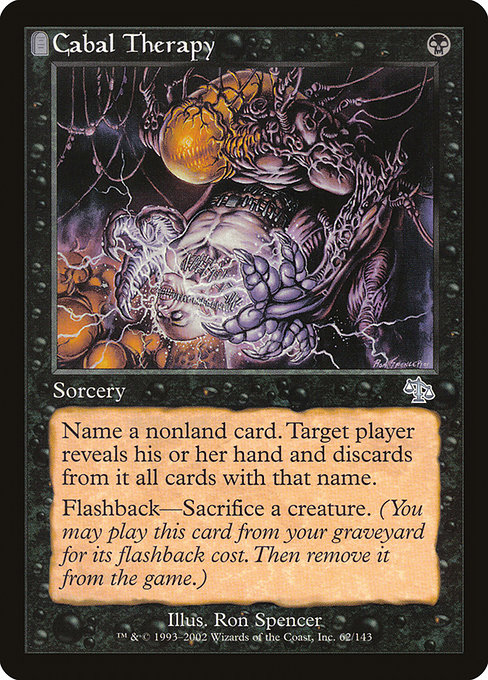
Cabal Therapy is a one-black-mana sorcery that names a nonland card; the opponent reveals their hand and discards all copies of the named card. Unlike Duress, you do not get to see the hand first — you must name a card blind. However, Cabal Therapy has a flashback cost: sacrifice a creature, and you may cast it again from the graveyard for free. The flashback version can be timed perfectly because you’ve now seen the opponent’s hand from the first cast (you chose what they discard), allowing the second name to hit precisely. This two-cast structure makes Cabal Therapy one of the most powerful disruption spells in Premodern when combined with a sacrifice outlet.
When it’s played
Cabal Therapy appears in black-based combo, aggro-control, and Reanimator strategies.
- Reanimator uses Cabal Therapy as the primary disruption piece — naming Swords to Plowshares or Counterspell on the first cast, then flashing it back by sacrificing a creature (often via Shallow Grave recovery) to take the second target.
- Deadguy Ale pairs Therapy with Cabal Therapy plus Duress for a multi-layered disruption suite.
- Cephalid Breakfast uses Therapy as both disruption and a way to mill its own library via the self-sacrifice line.
- The Rock and midrange black-green decks include it as their strongest disruption spell against control.
The math / interaction worth knowing
The naming decision on the first cast is the skill floor. You name a card without seeing the hand, so you need to rely on metagame reads, opponent’s archetype, and any visible information. Against a known Goblins player: name Goblin Lackey. Against a Replenish player who played an Island on turn one: name Counterspell. Against a known Reanimator player: name Animate Dead. If you get one copy from the first name, you’ve generated value. If you miss (their hand has none of the named card), Therapy was a blank.
The flashback makes misses cheaper. Even if you miss on the first cast, you now see the opponent’s hand by waiting — because they must show you the cards they reveal. Actually, the card says “Target player reveals their hand.” You always see the hand on the flashback because you sacrificed a creature to cast it at instant speed, and you’ve already seen their hand from the first cast (which showed zero copies of your named card and therefore revealed what they do have). This means on the flashback, you name precisely — take the most relevant spell remaining.
Cabal Therapy enables sacrifice-based synergies. Any creature you want to sacrifice — a Carrion Feeder that has grown, a creature you fetched with Entomb and Animate Dead that has already served its purpose, or a token from Siege-Gang Commander — can pay the flashback cost. In Reanimator, sacrificing the reanimated creature to flash back Therapy is a common line: you got the body into play, attacked, then sacrificed it to strip the opponent’s remaining interaction.
Decklists worth studying
When deck data populates, look for Reanimator and Cephalid Breakfast lists from MTGO Premodern Challenges. The Therapy line in Reanimator frequently involves a turn-one Entomb into Animate Dead, followed by flashback Therapy (sacrificing the reanimated creature) to clear the path.
Related cards
- Duress — The complementary discard spell that sees the hand first; pairs with Therapy for double disruption.
- Entomb — In Reanimator, the creature Entombed is sometimes the sacrifice fodder for Therapy’s flashback.
- Animate Dead — Enables the Reanimator line where the reanimated creature becomes Therapy flashback fodder.
- Carrion Feeder — The sacrifice outlet that enables Therapy flashback in Cephalid Breakfast builds.
- Dark Ritual — Enables turn-one Therapy in black combo builds.
- Counterspell — The card Therapy most commonly names against blue opponents on the first cast.