Card essay · City of Brass
City of Brass in Premodern: the life-per-tap tax and which decks can absorb it
What it does
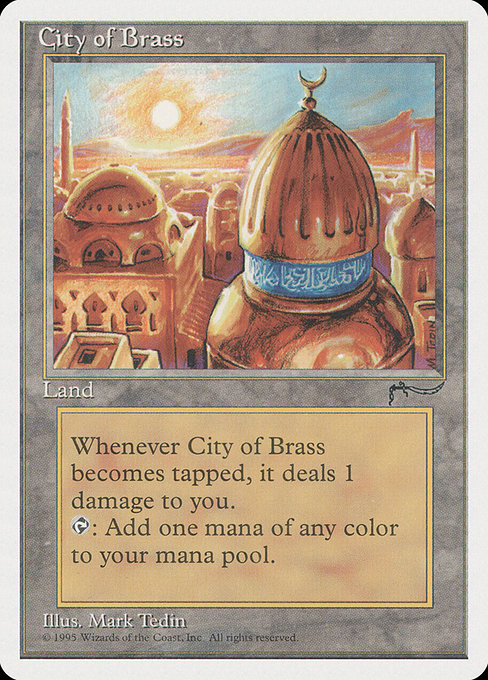
City of Brass is a land that produces one mana of any color when tapped, but deals one damage to you when it becomes tapped for any reason. The tap trigger fires whenever City of Brass is tapped — for mana, for a tap effect, or by an opponent’s effect like Rishadan Port. In the early turns, City of Brass enables multi-color strategies by providing any color needed. Over a long game, the cumulative life loss adds up — six or seven activations on a City is six or seven damage. This is why City of Brass is found in aggressive and combo decks more than in control strategies: aggressive decks plan to win before the life loss matters.
When it’s played
City of Brass is the format’s primary multi-color mana fixer.
- Goblins runs City of Brass to support a black splash (for Cabal Therapy or Patriarch’s Bidding in Goblin Bidding) alongside a primarily red mana base.
- Aluren uses City of Brass to support its four-color configuration (white, blue, black, green).
- Reanimator includes it alongside Gemstone Mine for the black-green-white configurations.
- Stiflenought uses it for the blue-black mana base.
- Many multi-color midrange and combo decks include City of Brass as the most reliable any-color source.
The math / interaction worth knowing
Rishadan Port tapping City of Brass still triggers the damage. If an opponent taps City of Brass with Rishadan Port, you take one damage even though you did not choose to tap it for mana. This is a meaningful consideration against Goblin lists — if your opponent Port-locks your City of Brass repeatedly, the incidental damage accumulates faster than you might expect. Against Goblin strategies with Port, City of Brass contributes to a compressed life total that makes Lightning Bolt or Cursed Scroll lethal earlier.
The damage is not optional. The triggered ability from City of Brass fires whenever it becomes tapped, not just when you use it for mana. There is no way to tap City of Brass for mana without taking the one damage. This is different from Gemstone Mine — Mine depletes its counters (eventually sacrifices) but does not deal damage.
City of Brass in a build-your-own-mana-base. Premodern has no fetchlands, so the typical approach to multi-color mana bases is: as many of the appropriate dual lands as possible (none exist in Premodern — there are no fully dual lands), then City of Brass, then Gemstone Mine, then the next-best color fixer for the specific combination. The “dual lands” in Premodern are primarily the Mirage-era painlands and taplands, which are inferior. City of Brass and Gemstone Mine bear more of the multi-color weight than in any other non-one-mana-per-land format.
Decklists worth studying
When deck data populates, look for Aluren and Reanimator lists from MTGO Premodern Challenges. The City of Brass count and the mix with Gemstone Mine reveals how much multi-color stress the deck places on its mana base.
Related cards
- Gemstone Mine — The complementary multi-color land; finite activations but no life damage.
- Mox Diamond — The Reserved List mana accelerant that pairs with City of Brass in luxury multi-color builds.
- Rishadan Port — Taps City of Brass, triggering the one-damage effect; a vulnerability to account for.
- Lotus Petal — Zero-cost mana that supplements City of Brass in combo builds.
- Cabal Therapy — The black disruption spell that City of Brass enables in otherwise non-black decks.
- Counterspell — City of Brass in blue-based decks ensures the double-blue requirement is always available.