Card essay · Daze
Daze in Premodern: the free counter, the land-return cost, and the mana curve it demands
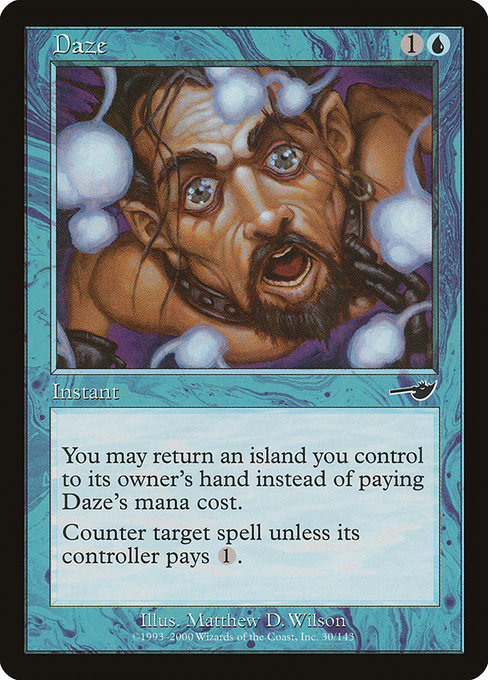
What it does
Daze counters target spell unless its controller pays one mana — but you can also return an Island you control to its owner’s hand to cast Daze for free (instead of paying its one-blue-mana cost). The free casting mode is what makes Daze exceptional: on turn two with one blue mana up, you can hold Daze as a “free” counter while using your other mana for development. The Island return is the downside — returning a land sets back your mana development by one turn.
When it’s played
Daze appears in tempo and aggressive blue strategies.
- Psychatog frequently includes Daze in the early-game counter suite, where the land-return cost is acceptable because the deck can operate on fewer lands in the early turns.
- Threshold builds leverage Daze as protection during the graveyard-filling phase when you’re light on mana anyway.
- Stiflenought uses Daze to protect Stifle from being countered during the Phyrexian Dreadnought sequence.
- Tempo decks that want cheap counters without committing two mana include Daze over Force Spike in formats where opponents have open mana after turn three.
The math / interaction worth knowing
Daze is most powerful on turns one and two, weakest after turn four. When you have one or two lands in play, returning one Island costs you proportionally more — going from one land to zero is catastrophically worse than going from five to four. This is the same reason Daze is strong in tempo builds: you are deliberately keeping land counts low, so the land return hurts less relative to the counter value. By turn four, an opponent casting a four-mana spell has three remaining mana to pay through Daze — making it a blank. After turn three or four, Daze is almost never free and should be saved or sideboarded out.
Daze cannot be used for free unless you return an Island specifically. Forests, Swamps, City of Brass, Mishra’s Factory — none of these count. Only a card with the subtype Island works. Multi-color decks splashing blue that don’t run basic Islands cannot use Daze for free. If your blue-white deck only runs plains and Tundra variants (none available in Premodern — Flood Plain is the equivalent), you need to confirm the Island subtype.
Daze and Force Spike are not identical. Force Spike taxes one mana that the opponent must pay. Daze also taxes one mana but allows you to cast Daze for free. Against an opponent with open mana, Force Spike is slightly better — they pay one. Against an opponent who is tapped out, both are identical counters. Daze has the upside of the free casting mode; Force Spike does not require returning a land.
Decklists worth studying
When deck data populates, look for Threshold and Psychatog lists from MTGO Premodern Challenges. The Daze-Force Spike mix reflects the pilot’s assessment of how often opponents tap out in the early turns.
Related cards
- Force Spike — The comparable one-mana conditional counter; different tradeoffs in different situations.
- Counterspell — The unconditional follow-up once Daze becomes unreliable past turn three.
- Stifle — In Stiflenought, Daze protects Stifle from being countered.
- Brainstorm — Finds Daze and other counters in tempo builds.
- Mishra’s Factory — Not an Island; cannot be returned for Daze’s free cost.
- Threshold — The mechanic that Daze-Threshold decks are building toward; Daze enables development while fueling the counter suite.