Card essay · Diabolic Edict
Diabolic Edict in Premodern: the sacrifice removal that bypasses protection and how to play around it
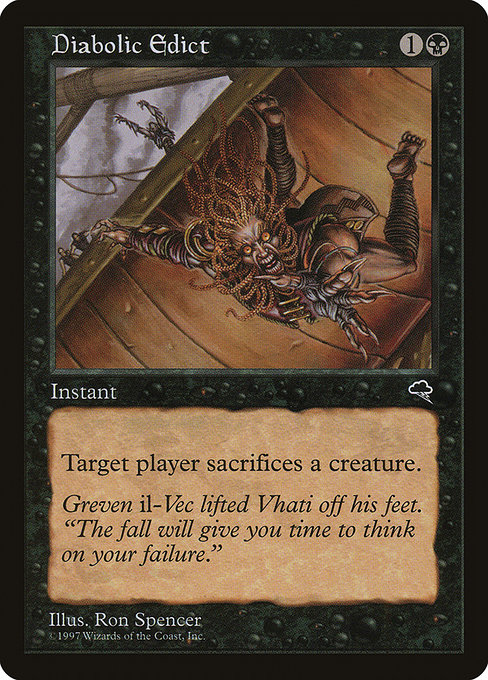
What it does
Diabolic Edict costs two mana (one black and one generic) at instant speed and forces the target player to sacrifice a creature. The player chooses which creature to sacrifice — you cannot name a specific creature. This distinction is critical: Diabolic Edict is not targeted removal. It is a targeting effect on a player, not a creature. This means it bypasses shroud (which protects against targeting), protection from black (which only works against spells and effects that target the creature), and any ability that says “this creature cannot be targeted.”
When it’s played
Diabolic Edict is the primary black removal for creatures with shroud or protection.
- Mono-Black Control runs Diabolic Edict as the answer to Morphling (shroud) and creatures with protection from black.
- Deadguy Ale includes Edict as black-splash removal.
- Pox uses Edict as part of a suite of forced-sacrifice effects alongside the namesake card.
- Some The Rock builds include Edict as targeted removal that hits shroud creatures.
The math / interaction worth knowing
Diabolic Edict targets a player, not a creature. This is the rules distinction that makes Edict work against shroud and protection. Morphling has shroud, which means it cannot be the target of spells or abilities. But Diabolic Edict targets the player controlling Morphling, not Morphling itself. The player is forced to sacrifice a creature — and if Morphling is their only creature, Morphling is sacrificed.
Playing around Diabolic Edict with tokens. If you have Morphling and a 1/1 token in play, and your opponent casts Diabolic Edict, you sacrifice the token instead of Morphling. This is the primary play-around: never allow yourself to control exactly one creature when Diabolic Edict is a likely answer. Tokens from Decree of Justice or Siege-Gang Commander serve as Edict protection.
Diabolic Edict at instant speed. You can cast it on the opponent’s turn in response to a spell or ability. More commonly: you cast it on your turn to clear a blocker, or on the opponent’s attack step. The instant speed allows it to interact with Goblin Lackey triggers — if Lackey’s trigger fires (when Lackey deals damage), you can Diabolic Edict in response, but the trigger has already resolved by then. Instead, Edict a Lackey before the attack step to prevent the attack entirely.
Decklists worth studying
When deck data populates, look for Mono-Black Control lists from MTGO Premodern Challenges. Diabolic Edict count reflects the pilot’s expectation of shroud or protection creatures in the field.
Related cards
- Swords to Plowshares — The white parallel; Swords exiles the targeted creature specifically, bypassing Edict’s play-around.
- Morphling — The primary shroud creature Diabolic Edict is used to answer.
- Cabal Therapy — Co-played in black disruption suites.
- Dark Ritual — Enables turn-one Diabolic Edict for urgent removal.
- Pernicious Deed — The board-reset that clears creatures Edict cannot handle (multiple threats).
- Decree of Justice — Creates tokens that can be sacrificed to Edict instead of key creatures.