Card essay · Duress
Duress in Premodern: the first-turn information and when to name a land
What it does
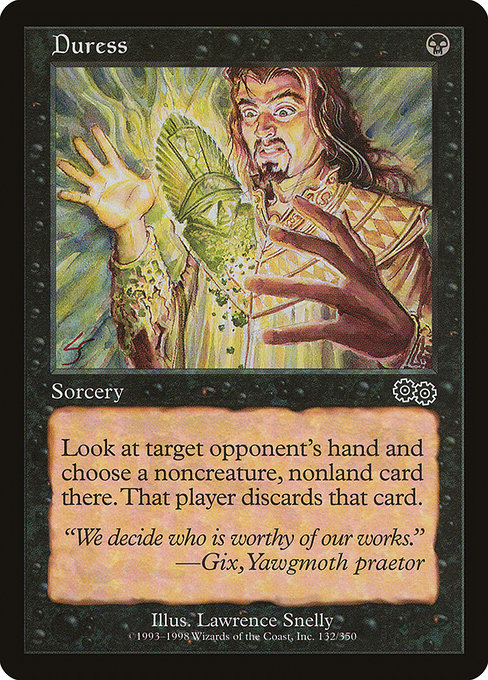
Duress costs one black mana at sorcery speed and lets you look at the opponent’s hand and take a noncreature, nonland card. It cannot hit creatures or lands, which means it misses the most common card types in the format but hits spells, enchantments, artifacts, and planeswalkers with reliability. Against combo decks, Duress is the most efficient possible disruption — it takes the key piece before it can be played. Against control decks, it strips a counterspell or a key spell. Against aggro decks with only creatures and lands, Duress is often a blank.
When it’s played
Duress is a key sideboard and mainboard card in black-based strategies.
- Deadguy Ale often runs Duress in the main alongside Cabal Therapy as a full discard suite.
- Mono-Black Discard runs four copies mainboard as a core piece of the hand-disruption plan.
- Reanimator frequently sideboard Duress to strip the opponent’s Swords to Plowshares or Counterspell before the key reanimation turn.
- Doomsday uses Duress to clear the path before casting the namesake sorcery.
- Many other black-splash sideboards include one or two copies for combo matchups.
The math / interaction worth knowing
Duress gives you perfect information about the opponent’s hand. You see all their cards and take the one you want. This is not just about removing a threat — it is about planning the next three turns with complete knowledge of their resources. If you see a hand with Counterspell, Force Spike, Brainstorm, and Morphling, you should take Force Spike if you plan to cast a key spell next turn with four mana available (making Force Spike taxable) or Counterspell if your key spell costs three or less.
Duress cannot take lands, which limits it against pure aggro. Against Goblins, a hand of four creatures and two lands gives Duress nothing to take if there’s no non-creature non-land card. In this case, Duress is a blank and you are better served by holding it for the sideboard of that matchup or swapping it out entirely. This is the key reason Duress is frequently in the sideboard rather than mainboard: it is excellent against blue control, combo, and any spell-heavy strategy, but dead against creature aggro.
Naming a land is illegal. The ability specifies “noncreature, nonland card.” If the opponent’s hand is all lands (which happens when they have flooded), Duress has no valid target and you cannot cast it legally by targeting it at them. Well: you can still cast it, but if all cards in their hand are lands and/or creatures, you see the hand and take nothing — which at minimum gives you the information, even if you discard nothing.
Decklists worth studying
When deck data populates, look for Deadguy Ale and Mono-Black Discard lists from MTGO Premodern Challenges. The full discard suite — Duress, Cabal Therapy, and Hymn to Tourach if legal — defines the black disruption plan.
Related cards
- Cabal Therapy — The sorcery-speed discard with a flashback; pairs with Duress for a full disruption suite.
- Hypnotic Specter — Continues disruption after Duress clears the initial hand.
- Dark Ritual — Enables Duress plus a two-mana spell on turn one in fast black builds.
- Swords to Plowshares — The card Duress most often takes from white-based opponents.
- Counterspell — The most common blue card Duress removes when facing control.
- Entomb — In Reanimator, Duress is cast first to strip the opponent’s interaction before the Entomb-Animate Dead sequence.