Card essay · Goblin Piledriver
Goblin Piledriver in Premodern: the power scaling, protection from blue, and why Warchief doubles it
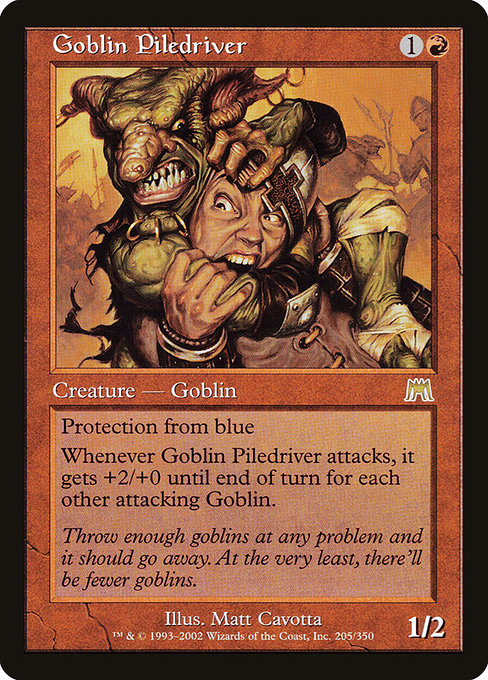
What it does
Goblin Piledriver is a two-mana 1/2 Goblin creature with protection from blue and a triggered ability: when Goblin Piledriver attacks, it gets +2/+0 for each other attacking Goblin. In a Goblins deck that can put four or five Goblins into play by turn three, Piledriver attacks as a 9/2 or 11/2. It dies to Lightning Bolt (barely — 1/2 baseline), but in an attacking position with multiple Goblins, the opponent’s removal is overloaded. Piledriver represents the explosive combat damage potential that makes Goblins one of the format’s most feared aggro decks.
When it’s played
Goblin Piledriver is core to Goblins and appears in variants.
- Goblins runs four copies as the primary damage engine. The interaction with Goblin Warchief (which reduces Goblin costs) and Goblin Lackey (which puts Goblins into play for free) creates the explosive opening.
- Goblin Bidding also runs Piledriver as part of the creature package that makes Patriarch’s Bidding so dangerous.
The math / interaction worth knowing
Protection from blue means Piledriver cannot be targeted by blue spells or blocked by blue creatures. In Premodern, the primary blue creatures that would block are Morphling and various 1/1 tokens — none are blue enough to be relevant. The protection from blue matters most for countermagic: Counterspell cannot counter Piledriver (it’s a spell targeting Piledriver), wait — protection from blue means Piledriver cannot be the target of blue spells. If Counterspell targets Piledriver specifically, it is prevented. But Counterspell typically counters the spell as it’s cast (before it resolves), not targeting the permanent after it’s in play. Actually: protection from blue means that blue sources deal no damage to Piledriver, effects from blue spells don’t apply to Piledriver, and Piledriver can’t be blocked by blue creatures. Counterspell counters Piledriver when it’s being cast (still a spell on the stack), so protection from blue does not help there — the counter targets the spell, not the creature. Once Piledriver resolves, it can’t be targeted by blue instants like Unsummon or affected by blue creature removal.
The +2/+0 bonus applies during the attack step and counts all other attacking Goblins. If four Goblins attack (Piledriver plus three others), Piledriver is +6/+0 and attacks as a 7/2. With Goblin Warchief in play, each other Goblin costs one less — enabling more Goblins to be cast before the attack step, further amplifying Piledriver’s bonus.
First strike plus the combat bonus. Piledriver has no first strike, so a 7/2 Piledriver trading with a 4/4 blocker both die. The Goblins pilot often needs to assess whether forcing through Piledriver damage (taking the trade) or holding back (losing the bonus) is correct. In races, Piledriver’s damage is frequently worth any trade.
Decklists worth studying
When deck data populates, look for Goblins lists from MTGO Premodern Challenges. The Lackey-Warchief-Piledriver opening is visible in any successful list.
Related cards
- Goblin Warchief — Gives other Goblins haste and reduces costs; enables more attackers for Piledriver’s bonus.
- Goblin Lackey — Puts Goblins into play from hand; each one pumps Piledriver by +2.
- Goblin Matron — Finds Piledriver when needed; is itself a Goblin that contributes to Piledriver’s bonus.
- Rishadan Port — Prevents blockers from being available; creates open lanes for Piledriver.
- Wasteland — Destroys blockers and mana sources; enables Piledriver swings into stabilizing opponents.
- Siege-Gang Commander — The top-end Goblin; Piledriver swings as an even larger creature with a Commander and its tokens in play.