Card essay · Lightning Bolt
Lightning Bolt in Premodern: why three damage at instant speed is still the format's most efficient burn spell
What it does
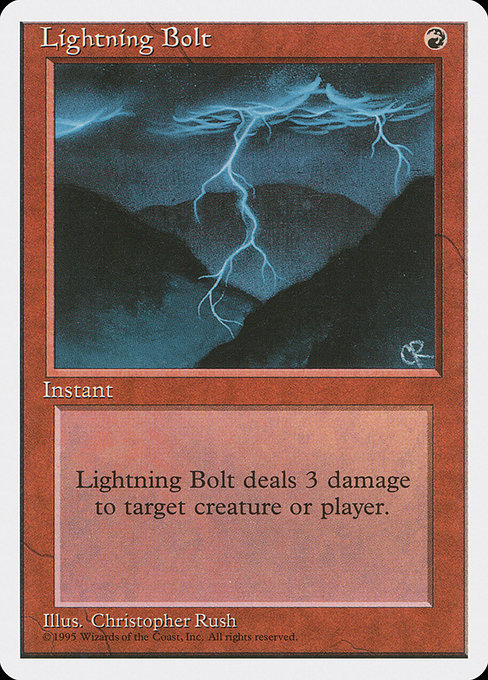
Lightning Bolt deals three damage to any target for a single red mana at instant speed. In a format where many of the most dangerous creatures — Goblin Lackey, Wild Mongrel, Nimble Mongoose — die to exactly three damage, and where the difference between three damage and two damage often determines which creatures survive, Lightning Bolt is the format’s premier point-removal spell. Decks that want to control the board and clock the opponent simultaneously cannot do better at one mana.
When it’s played
Lightning Bolt is a core card in red-based strategies across Premodern.
- Sligh runs four copies as the primary reach card — Lightning Bolt to the face is the plan when the opponent stabilizes the board.
- Goblins runs it in the sideboard and sometimes the mainboard to address specific threats that Goblin creatures cannot profitably attack into.
- Angry Hermit uses it alongside Pillage for a removal suite that also pressures mana.
- RG Zoo includes it as the cheapest way to clear the path for Kird Ape and Gorilla Shaman attacks.
- UR Madness leverages it for double duty: removal and reach, often discarding through Wild Mongrel to enable madness on Fiery Temper.
The math / interaction worth knowing
The three-damage threshold defines the format’s threat sizing. Premodern was designed before creatures consistently outpaced spells; most relevant creatures from 1995-2003 have one or two toughness. The dominant exception is Morphling, which survives Lightning Bolt by pumping, and Phyrexian Negator, which forces you to choose between the two or five toughness. Creatures at exactly 3 toughness — Hypnotic Specter, Goblin Warchief — are cleanly handled by Lightning Bolt without needing to sequence additional removal.
Instant speed matters against Threshold decks. Nimble Mongoose is a 3/3 shroud once Threshold is active and cannot be targeted. But in the window between the opponent reaching six cards in graveyard and ending their turn, you have the opportunity to Lightning Bolt a 1/1 Nimble Mongoose before it gets shroud. The timing is narrow but real: if you hold Lightning Bolt for that window rather than firing it at a tapped creature on your turn, you can preempt the Threshold ability. This requires knowing the opponent’s graveyard count.
Three damage to the face is meaningful reach. In a format with no fetchlands, life totals can be padded against burn strategies by simply playing basics. But Sligh and Burn decks that run twenty-four copies of direct damage between four Lightning Bolts, four Fireblasts, and other spells reach twenty damage by turn five consistently in goldfishing. Lightning Bolt’s contribution is roughly 3/20 = 15% of the damage required, but its efficiency (one mana for three damage) makes it the highest-value spell in the suite.
Decklists worth studying
When deck data populates, look for Sligh lists from the Duress Crew data and MTGO Premodern Challenges. Budget Sligh builds frequently run Lightning Bolt as their only removal; premium builds pair it with Cursed Scroll for reach against life-gain opponents.
Related cards
- Cursed Scroll — The other ubiquitous Sligh damage source; Scroll scales into lategame where Lightning Bolt does not.
- Fireblast — The free finisher that pairs with Lightning Bolt in Burn and Sligh to deal the final points of damage.
- Goblin Lackey — In Goblins, Lightning Bolt clears the path for Lackey’s combat damage trigger.
- Pillage — Often in the same 75 as Lightning Bolt in Angry Hermit and RG builds.
- Fiery Temper — The madness companion to Lightning Bolt in UR Madness; together they form the damage suite.
- Wild Mongrel — In Madness and Zoo builds, Mongrel enables discarding Fiery Temper while Lightning Bolt handles removal duties.