Card essay · Memory Lapse
Memory Lapse in Premodern: why putting a spell on top of the library is often better than countering it
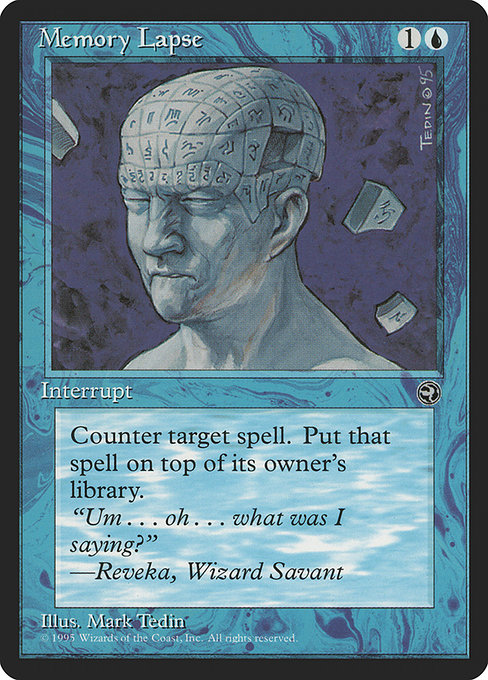
What it does
Memory Lapse counters target spell and puts it on top of its owner’s library instead of in the graveyard — for one blue and one generic mana at instant speed. The spell is not countered into the graveyard (no graveyard-based recursion), but it is also not “removed” — the opponent draws it next turn and can cast it again. What Memory Lapse actually does is buy one turn at instant speed, and in Premodern’s slower format environment, one turn is frequently decisive.
When it’s played
Memory Lapse is a common piece in blue tempo and control lists.
- Psychatog uses Memory Lapse as a tempo piece in the early game — counter an expensive threat, draw your own threat, attack.
- Landstill pairs it with Counterspell: Lapse the early spell to buy time, Counterspell the expensive spell when they find mana.
- Mono-Blue Control runs Memory Lapse alongside Force Spike as its suite of two-mana interaction.
- Threshold builds sometimes include it as the cheapest available hard answer to expensive spells.
The math / interaction worth knowing
Memory Lapse costs two mana against a three-or-more-mana spell, which creates a tempo advantage. If your opponent taps four mana to cast Replenish and you Memory Lapse it, they spent their entire turn and now they have a Replenish on top of their library and drew nothing new. On your next turn, you drew a card, developed your board, and their Replenish is still un-cast. This one-turn tempo differential compounds: they spend turn four again drawing the Replenish, which you can now Counterspell, and you are effectively two turns ahead in development.
Memory Lapse generates card advantage in a specific sense. When you Memory Lapse a spell, your opponent draws that spell again next turn instead of a new card. You drew a new card in your draw step. The net effect: you are effectively drawing one card ahead of your opponent per Memory Lapse that resolves. Against decks that are top-decking threats, this is equivalent to Time Walk in a limited sense — your opponent’s top-deck “finds” the card they already had.
Memory Lapse can be chained with a second counter. If you Memory Lapse on turn two and then hold a Counterspell for turn three, you create a two-turn lock: Lapse now, Counterspell their redraw. This is the core Psychatog and Landstill counter sequence. The opponent must break through the chain or find a second copy from their own hand (not the top of the library).
Decklists worth studying
When deck data populates, look for Psychatog and Landstill lists from MTGO Premodern Challenges. The Lapse-to-Counterspell sequence is explicitly visible in how these pilots structure their counter suite ratios.
Related cards
- Counterspell — The hard counter that pairs with Memory Lapse for the two-step counter sequence.
- Force Spike — The one-mana conditional that handles turn-two threats before Memory Lapse is optimal.
- Brainstorm — Finds Memory Lapse and Counterspell; often cast at end of turn to reload after holding up counters.
- Psychatog — The primary win condition that benefits from a tempo counter suite including Memory Lapse.
- Daze — The other two-mana equivalent (return a land, counter for free); different timing than Memory Lapse.
- Standstill — In Landstill, Memory Lapse holds the Standstill lock while Factory attacks.