Card essay · Pernicious Deed
Pernicious Deed in Premodern: the reset button that scales and when to crack it
What it does
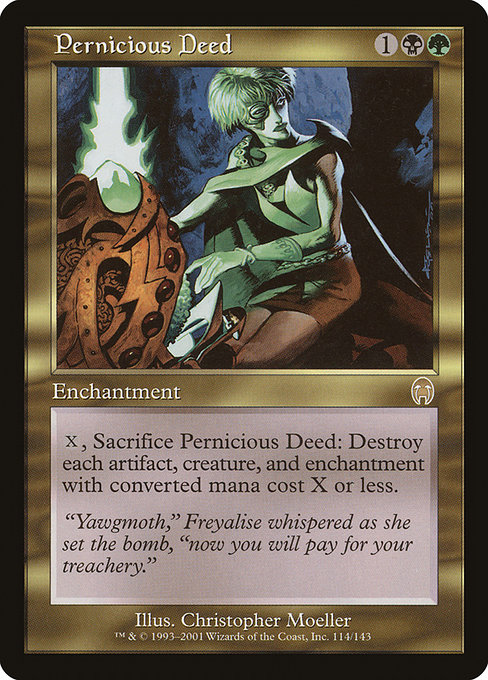
Pernicious Deed costs two mana (one black, one green) to play and has an activated ability: pay X mana and sacrifice it to destroy all artifacts, creatures, and enchantments with converted mana cost X or less. The flexibility of X means Deed can be calibrated to the exact threat level — clear tokens (X=0), clear early creatures (X=2), or wipe the entire non-land battlefield at high X values. It is one of the format’s best board-reset spells and the defining card of green-black midrange.
When it’s played
Pernicious Deed is the core midrange stabilizer in Premodern.
- The Rock (BG midrange) runs four copies as its primary board-control tool. The deck develops slowly with disruption and then cracks Deed to reset into a dominant position.
- BUG Survival uses Deed alongside Survival of the Fittest for a controlling midrange game.
- Pox sometimes includes Deed as additional board-clearing technology.
- Some Living Death builds use Deed to clear the board before casting Living Death for a fresh start with their own graveyard threats.
The math / interaction worth knowing
Deed destroys your own permanents too. When you crack Deed at X=3, every artifact, creature, and enchantment with CMC three or less on the entire battlefield — yours and the opponent’s — is destroyed. This means Deed lists are built to avoid committing permanents below the chosen X threshold before cracking. The Rock runs few low-cost permanents (no one-drop creatures) so that cracking Deed at X=2 or X=3 clears the opponent’s board while leaving The Rock’s position more intact.
Deed does not touch lands. Lands have no converted mana cost (they are 0 mana to cast, but as permanents in play, their CMC is not 0 — actually the Deed ability specifically says “permanents with CMC X or less,” and lands don’t have a mana cost, which means their CMC is zero). In practice, lands are destroyed at X=0. Wait — Deed’s text says “destroy all artifacts, creatures, and enchantments” — it does not hit lands at all. Lands are safe from Deed regardless of X. This is the key reason Deed is good in land-based strategies: the opponent’s utility lands (Mishra’s Factory, Wasteland) survive Deed, but their creatures and artifacts do not.
The timing of Deed activation is the key skill. Deed can be activated at instant speed — it’s an activated ability with no “sorcery speed only” restriction. You can crack Deed on the opponent’s combat step to clear their attacking creatures before they deal damage. You can crack it on the opponent’s main phase in response to a key spell. The hold versus crack decision is the core skill: hold until the opponent overcommits (more permanents below the X threshold), then crack.
Decklists worth studying
When deck data populates, look for The Rock and BUG Survival lists from MTGO Premodern Challenges. The X value chosen in tournament games tracks the format’s threat sizes — cracking at X=2 covers most early creature aggro; X=3 handles Threshold creatures and utility artifacts.
Related cards
- Survival of the Fittest — Co-played in BUG Survival; Survival finds threats while Deed controls the board.
- Living Death — In Living Death builds, Deed clears the board before the namesake sorcery.
- Wrath of God — The white parallel — unconditional, no scaling, destroys everything.
- Wall of Roots — Common accelerant in Deed-based decks; cracking Deed at X=2 hits it though.
- Cabal Therapy — The disruption suite companion in The Rock; Therapy strips key spells while Deed handles the board.
- Duress — Clears the counterspell that would counter Deed.