Card essay · Sleight of Hand
Sleight of Hand in Premodern: the one-mana cantrip that digs deeper than Opt and the shuffle distinction
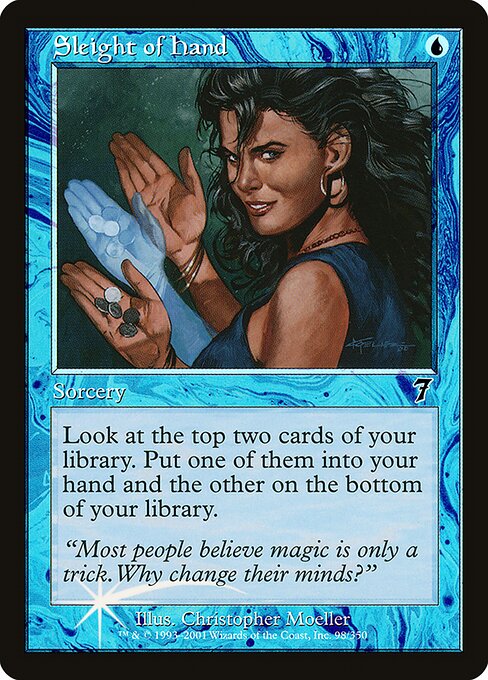
What it does
Sleight of Hand is a one-blue-mana sorcery that looks at the top two cards of your library, puts one into your hand, and puts the other on the bottom. It is a cantrip in the “draw deeper” sense — you effectively see two cards and keep the better one, putting the worse one out of reach for the rest of the game. Unlike Brainstorm, which draws three and puts two back, Sleight of Hand is entirely a filtering effect: you improve the quality of your draw by discarding one of two options. The cost is sorcery speed.
When it’s played
Sleight of Hand appears in blue-based combo and control decks that want to maximize consistency.
- Psychatog sometimes includes Sleight of Hand alongside Brainstorm for a full cantrip suite.
- Mono-Blue Control uses it as an additional filtering effect to find key spells.
- Stiflenought uses Sleight of Hand to find Stifle and Phyrexian Dreadnought more consistently.
- Doomsday uses it to set up the Doomsday pile by seeing two cards before the namesake sorcery resolves.
The math / interaction worth knowing
Sleight of Hand sees two cards; Brainstorm sees three. The ceiling on Brainstorm is higher — three cards minus two returns is a net draw of one card with maximum filtering of two cards seen. Sleight of Hand’s ceiling is filtering one card (keeping one of two). However, Sleight of Hand does not suffer from the “Brainstorm lock” — putting two bad cards back on top of your library. What you see with Sleight of Hand goes to the bottom, never to the top, so you cannot strand yourself.
Sorcery speed matters significantly. Sleight of Hand cannot be cast at instant speed. You must cast it on your turn, which means you cannot use it as an end-of-turn filter (the Brainstorm pattern). In tempo decks that want to hold mana up for counters, Sleight of Hand is sometimes a liability — casting it on your turn means spending mana that could hold up a Force Spike or Memory Lapse.
The bottom-of-library placement is permanent. The card you do not choose goes to the bottom of your library. Against opponents with shuffle effects, this is irrelevant. In a non-shuffle game, you will not see the bottomed card again until you have drawn your entire library — which in a 60-card deck with twenty cards in graveyard means roughly forty turns. For practical purposes, the card is removed from your deck for the rest of the game.
Decklists worth studying
When deck data populates, look for Psychatog and Stiflenought lists from MTGO Premodern Challenges. The Brainstorm-Sleight of Hand ratio in these lists reflects the pilot’s preference for depth versus flexibility in filtering.
Related cards
- Brainstorm — The cantrip that sees more cards but requires management to avoid the lock; Sleight of Hand is the simpler alternative.
- Counterspell — The spell Sleight of Hand most often finds in control builds.
- Stifle — In Stiflenought, Sleight of Hand finds the combo piece.
- Phyrexian Dreadnought — The other Stiflenought piece Sleight of Hand helps find.
- Psychatog — The primary win condition that benefits from Sleight of Hand’s filtering.
- Force Spike — The counter Sleight of Hand finds in tempo builds; the sorcery speed timing conflict is a real consideration.