Card essay · Sneak Attack
Sneak Attack in Premodern: the haste-granting cheat engine and what makes its window so narrow
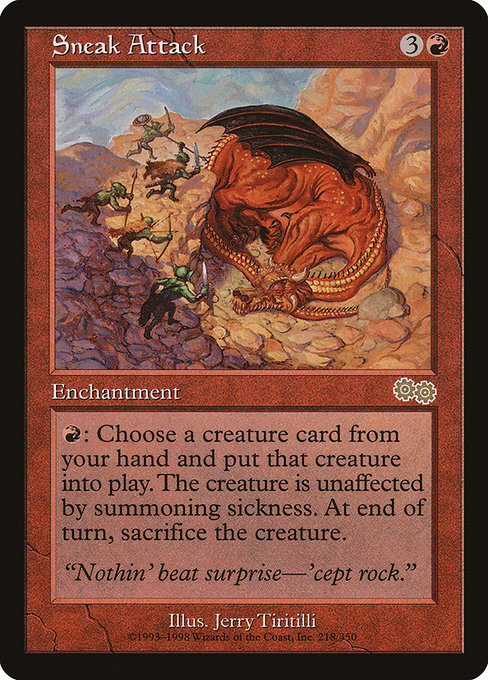
What it does
Sneak Attack costs four red mana and has an activated ability: for one red mana, you can put any creature from your hand into play and it gains haste — but you must sacrifice it at the end of turn. The creature attacks immediately and provides one turn of combat damage before going to the graveyard. For creatures with game-ending enters-the-battlefield abilities or very high power, one attack is sufficient to win. Sneak Attack is on the Reserved List (Urza’s Saga, 1998) and is among the format’s most expensive cards.
When it’s played
Sneak Attack is the namesake card of the Sneak Attack archetype, one of Premodern’s powerful combo strategies.
The Sneak Attack deck fills the library with large creatures — Verdant Force, Sundering Titan (if available in pool), and high-impact attackers — and uses Gamble, Intuition, and Entomb to find Sneak Attack and the right creature. The kill sequence involves Sneaking in a creature with either direct-damage triggers (Siege-Gang Commander, Crosis, the Purger) or raw power sufficient to end the game in one attack. Because the creature is sacrificed at end of turn, the opponent typically has one combat phase to deal with the problem — but they cannot remove it from combat after the damage is dealt.
The math / interaction worth knowing
The sacrifice happens at end of turn, not at the end of combat. This is important because it means the creature is in play during the “main phase 2” of your turn. If the sneaked creature has an enters-the-battlefield trigger — like Siege-Gang Commander generating Goblin tokens — those tokens remain in play after the Commander is sacrificed. The one-turn window is defined as: enter at your upkeep or main phase, attack in combat, deal damage, then sacrifice at end of turn. You get the combat damage and any triggered abilities from the attack, but not another turn with the creature.
Sneak Attack requires one red mana per creature. You can Sneak multiple creatures in the same turn by paying {R} for each one. A two-land plus Mox Diamond opening that results in Sneak Attack in play on turn four can then Sneak up to four creatures in a single attack step if you have four red mana available. The practical ceiling is two or three per turn given typical land counts.
Haste is mandatory on Sneaked creatures. They have haste, so they can attack immediately. But they cannot be held back to block — they are sacrificed at end of turn regardless of whether they attacked. The “you must sacrifice it” clause means you cannot keep the creature around by not attacking. This is relevant for protective plays: if you Sneak in a blocker to prevent damage, it still goes away at end of turn.
Finding Sneak Attack is the bottleneck. Gamble (discard at random if it finds the card) and Intuition (opponent chooses one of three) are the main tutors. The deck manages the variance of these tutors by building a large enough density of quality targets that any of the Intuition piles are acceptable.
Decklists worth studying
When deck data populates, look for Sneak Attack lists from MTGO Premodern Challenges. The typical configuration includes four Sneak Attacks, multiple high-impact creatures, and a suite of tutors.
Related cards
- Entomb — Puts creatures directly in the graveyard for Sneak Attack combo or backup reanimation.
- Gamble — The primary tutor for finding Sneak Attack; the random discard can be a feature if it dumps a creature for Animate Dead.
- Mox Diamond — Enables turn-three or earlier Sneak Attack.
- City of Brass — Mana fixing for the Sneak Attack deck’s red plus other color requirements.
- Animate Dead — Backup to Sneak Attack; after Sneaking a creature that was then sacrificed, Animate Dead can return it.
- Siege-Gang Commander — One of the creatures with enters-the-battlefield value in Sneak Attack lists; tokens survive the commander’s end-of-turn sacrifice.