Card essay · Standstill
Standstill in Premodern: the pseudo-Ancestral Recall and the game of who breaks it first
What it does
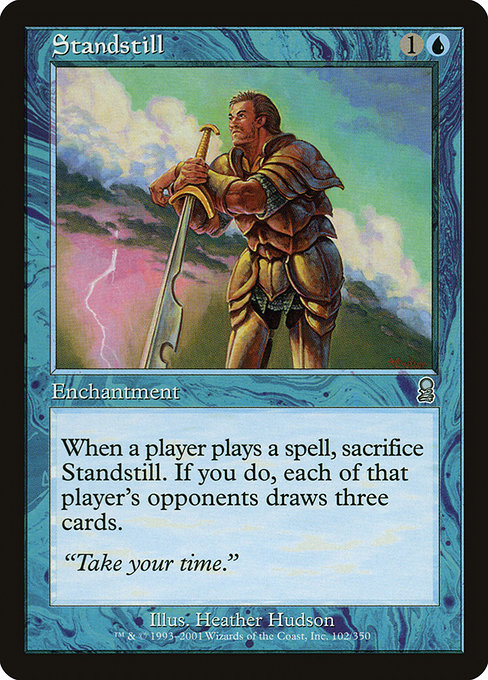
Standstill is a two-mana blue enchantment: whenever a player casts a spell, they sacrifice Standstill and the other player draws three cards. In a vacuum, Standstill punishes the opponent for playing Magic — they can either cast spells and give you three cards, or not cast spells and lose tempo while you continue to develop your board. The Landstill archetype is built entirely around this asymmetry, using Mishra’s Factory as a land (not a spell) that provides pressure without triggering Standstill’s sacrifice clause.
When it’s played
Standstill is the defining card of Landstill and occasionally appears as a sideboard card in other blue control strategies.
- Landstill runs four copies as the primary card-advantage engine. The deck uses Counterspell to prevent the opponent from breaking Standstill cheaply, and Mishra’s Factory as the win condition that does not trigger the enchantment.
- Some Mono-Blue Control builds include Standstill in the sideboard against other control decks where card advantage is the deciding factor.
The math / interaction worth knowing
The Standstill game is fundamentally about who has more to lose from not casting spells. An aggressive deck is under severe pressure with Standstill in play — their creatures in hand cannot be cast without triggering Standstill, giving you three cards and leaving them at card disadvantage. A control deck can sometimes wait under Standstill better, but the Landstill player has Mishra’s Factory applying clock. The pressure from Factory forces the opponent to either trade cards by casting a blocker (breaking Standstill, drawing you three cards) or take increasing damage.
Breaking Standstill costs the breaking player’s spell plus they do not draw. When a player casts a spell, they sacrifice Standstill and the other player draws three. This means the breaker: spent their turn and a spell, resolved nothing that “fights” through the Standstill (unless the spell is powerful enough to be worth minus-three cards), and may have just given the Landstill player enough cards to dominate the game. The Landstill player wants the opponent to break Standstill with a small spell — a one-mana counter or cantrip. The opponent wants to break Standstill only with a game-deciding spell (like a resolved Replenish or a creature that ends the game).
Standstill can be broken by the Landstill player too. If you have enough cards and want more action, you can cast a spell yourself to “break” Standstill and give your opponent three cards — but this is usually wrong unless the game state demands it. More commonly, Landstill pilots wait for the opponent to break it and draw three, then operate with that new hand.
“Land” activations do not trigger Standstill. Mishra’s Factory activating as a 2/2 Assembly Worker is a land ability — it does not trigger Standstill. Lands are not spells. The Factory can attack and deal combat damage while Standstill sits on the battlefield, applying clock without giving the opponent the draw-three benefit.
Decklists worth studying
When deck data populates, look for Landstill lists from MTGO Premodern Challenges. The factory count, counter suite, and Standstill copy count define the archetype.
Related cards
- Mishra’s Factory — The win condition that applies pressure without triggering Standstill.
- Counterspell — Prevents the opponent from breaking Standstill with a small spell.
- Brainstorm — Can be cast during Standstill (if you’re willing to break it) or after it’s been broken with three cards in hand.
- Wasteland — Destroys a Factory in the mirror and can activate (as a land ability) without triggering Standstill.
- Force Spike — Early disruption in Landstill’s counter suite.
- Memory Lapse — Extends the game while Standstill is in play; opponent’s spell on top of library does not break Standstill.