Card essay · Survival of the Fittest
Survival of the Fittest in Premodern: the tutor engine that turns redundancy into inevitability
What it does
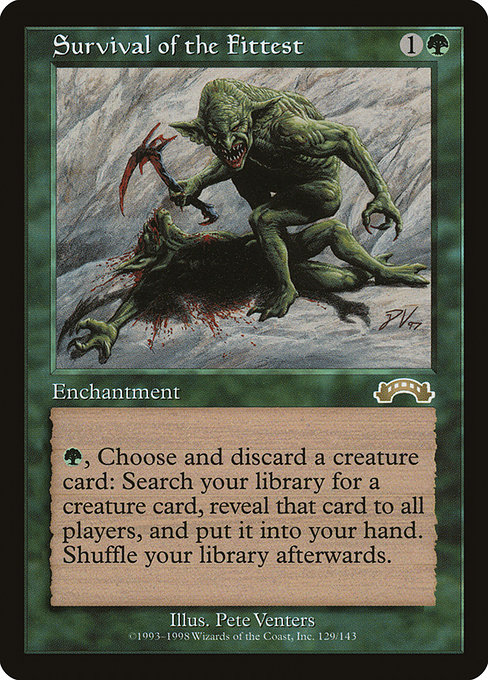
Survival of the Fittest is a one-green-mana enchantment with an activated ability: discard a creature card, then search your library for a creature card and put it in your hand. For one green mana plus a creature discard each activation, Survival converts any creature in hand into any creature in your deck. It is the format’s most powerful tutor effect because it does not have the ritual requirement of Entomb or the creature-on-the-battlefield requirement of other toolbox enablers — just mana plus a creature to discard. In a format with Recurring Nightmare legal, Survival creates infinite creature loops. It is on the Reserved List (Exodus, 1998).
When it’s played
Survival of the Fittest is the engine card for several Premodern archetypes.
- BUG Survival is named for the card. It runs Survival as the primary engine in a midrange-combo shell that uses Recurring Nightmare and Anger to generate an unbeatable board.
- Full English Breakfast uses Survival alongside Volrath’s Shapeshifter and Phyrexian Dreadnought to set up a 12/12 trampler.
- Living Death builds sometimes use Survival to fill the graveyard with creatures before casting Living Death as a board-reset plus threat deployment.
- Angry Hermit uses Survival to tutor Hermit Druid and set up a threshold-based kill.
The math / interaction worth knowing
The Survival-Recurring Nightmare loop is the format’s most efficient engine. Survival of the Fittest activates: discard Squee, Goblin Nabob, search for any creature. Since Squee returns to your hand at the beginning of each upkeep, you can discard Squee infinitely. With Survival active, you can search your library for Anger or any creature with a relevant ability, discard Squee each time. Once Anger is in the graveyard (with a Mountain in play), all your creatures have haste. With Recurring Nightmare in hand, you can then return any creature from your graveyard to the battlefield each turn while discarding another — creating a cycle that rebuilds any board state from any position.
Survival of the Fittest can only activate at sorcery speed… or can it? Survival’s activated ability has no explicit timing restriction — it is an activated ability of a permanent, which means it can be used at any point you could use an activated ability (your turn or opponent’s turn, any time you have priority). However, it is a mana ability that requires a green mana plus discarding a creature — it is not an instant in the traditional sense, but players treat it as having “instant speed” because there is no “sorcery speed only” restriction. In practice, activating Survival on your opponent’s end step is the optimal timing, letting you keep mana up for Counterspell on their main phase.
Survival is symmetric in theory but not in practice. Both players can potentially activate a Survival on the battlefield — but in practice, the player who controls Survival has already built their deck around the engine. The discard-creature requirement means you need creatures in hand, which the Survival player has specifically included.
Decklists worth studying
When deck data populates, look for BUG Survival lists from MTGO Premodern Challenges and mtgtop8 PREM events. The Squee-Recurring Nightmare-Anger combination is the canonical win condition — Survival finds each piece, and Squee’s return ability enables unlimited activations.
Related cards
- Recurring Nightmare — The engine that pairs with Survival for infinite creature recursion.
- Anger — Survival tutors Anger into the graveyard; with a Mountain, your entire team has haste.
- Squee, Goblin Nabob — The infinitely reusable discard target for Survival activations.
- Wall of Roots — The early ramp piece that enables Survival on turn two in green-based shells.
- Phyrexian Dreadnought — In Full English Breakfast, Survival tutors it to set up the Volrath’s Shapeshifter combo.
- Pernicious Deed — Frequently in the same 75 as Survival for board control.