Card essay · Swords to Plowshares
Swords to Plowshares in Premodern: the exile clause, the life payment, and why it is still the format's best removal
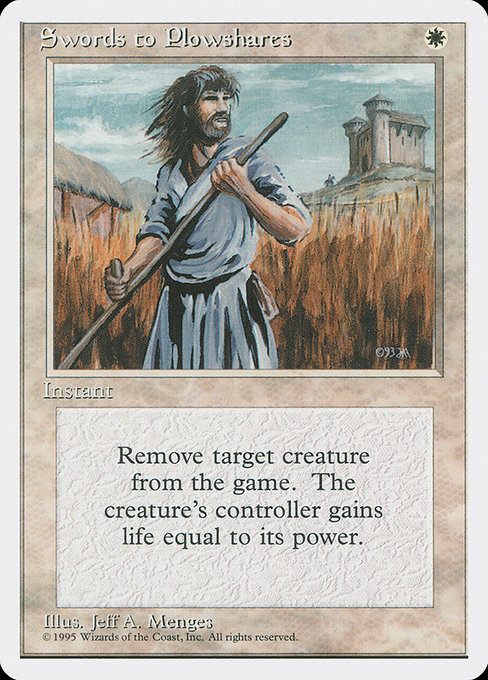
What it does
Swords to Plowshares exiles target creature and gives its controller life equal to that creature’s power — for one white mana at instant speed. It is unconditional in the sense that it hits any creature regardless of protection, regeneration, or toughness. The exile clause is the critical difference from “destroy” effects: creatures with regeneration die permanently to Swords to Plowshares, and creatures returned from the graveyard cannot return to life. The life payment is a real cost but rarely relevant in a format where winning requires reducing the opponent to zero, not to negative infinity.
When it’s played
Swords to Plowshares appears in white-based decks across the format.
- Deadguy Ale runs four copies as the format’s cheapest removal for any creature.
- GW Enchantress includes it to handle threats that would attack into the enchantment-based board.
- Replenish uses it alongside Counterspell for disruption.
- Mono-White Aggro and Mono-White Control both run the full set.
- Astral Slide uses Swords to Plowshares as primary creature removal.
- Wake includes it in the removal suite alongside Wrath of God.
The math / interaction worth knowing
The exile clause matters most against reanimation decks. Animate Dead and Recurring Nightmare cannot return an exiled creature. Swords to Plowshares on a Phyrexian Dreadnought preempts any subsequent reanimation attempt. This is the primary reason white-splash or white-based decks outperform other removal colors against the Reanimator archetype.
Life gain is symmetric but asymmetric in practice. Your opponent gains life equal to the creature’s power. For Goblin Lackey (power 1), that’s one life — irrelevant. For Morphling at 4/1 (power 4), that’s four life, potentially putting the opponent out of burn range. For Phyrexian Negator (power 5), that’s five life. The life payment is a consideration mainly when you’re using Swords to Plowshares as the last interaction before a burn-based kill — if your deck plans to deal twenty damage with burn spells, and you’ve already done fifteen, Swords-ing a Negator restores the opponent’s safety margin.
Swords to Plowshares can target your own creatures. This is an emergency play — exiling your own creature to gain its power worth of life. It preempts forced-sacrifice effects from Diabolic Edict or similar cards. It can also exile a creature that is about to be turned against you by a control-taking ability. These lines require precise sequencing to avoid giving the opponent time to respond.
Decklists worth studying
When deck data populates, look for Deadguy Ale and GW Enchantress lists from MTGO Premodern Challenges. Swords to Plowshares appears in virtually every white-based 75.
Related cards
- Wrath of God — The mass removal complement; Swords handles single threats, Wrath handles wide boards.
- Mother of Runes — In white aggro, protects your own creatures from opposing Swords to Plowshares.
- Diabolic Edict — The black parallel; edict does not exile and can be played around by giving your opponent a token.
- Counterspell — In blue-white decks, Counter protects the Swords window.
- Dark Ritual — In Deadguy Ale, dark ritual accelerates into Swords to Plowshares plus discard on turn one.
- Duress — Often in the same 75; discard to clear the path before playing Swords.