Card essay · Wasteland
Wasteland in Premodern: the land-destruction math and when to hold versus crack
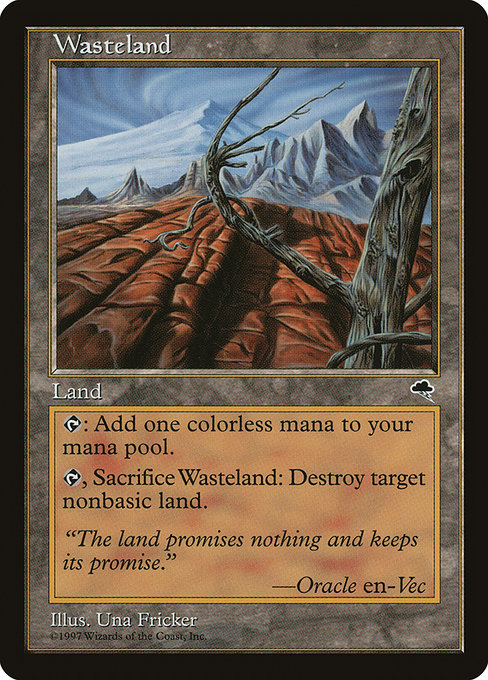
What it does
Wasteland is a non-basic land that taps for colorless mana or, by sacrificing itself, destroys any non-basic land an opponent controls. In Premodern, where basic lands are far less common than in Legacy and where many archetypes depend on utility lands like Mishra’s Factory, Rishadan Port, and City of Brass, Wasteland is an asymmetric mana denial tool that can end games by itself. The sacrifice is mandatory — once you activate Wasteland, it goes to the graveyard whether or not the land is successfully destroyed — but the effect resolves immediately under normal circumstances since lands don’t have protection or regeneration.
When it’s played
Wasteland is a fixture in several Premodern archetypes.
- Goblins runs a full set alongside Rishadan Port to lock opponents out of mana. The Port-Wasteland lock against multicolor decks can end games before turn four.
- Stiflenought uses Wasteland both defensively (destroying City of Brass in the opponent’s mana base) and offensively to ensure Phyrexian Dreadnought can attack into stabilized positions.
- Threshold decks often include it alongside Mishra’s Factory to apply pressure on mana while Werebear and Nimble Mongoose close out games.
- Mono-Black Control and Deadguy Ale variants use Wasteland to punish the multicolor mana bases that their opponents rely on for value.
The math / interaction worth knowing
Hold versus crack is the central skill question with Wasteland. The heuristic: crack Wasteland early against combo decks that are one mana away from going off; hold against control decks where the threat of Wasteland is worth more than the effect. Against a Replenish player, destroying their City of Brass on turn two can buy two or three turns before they find basics. Against a Goblin mirror, Wasteland on your opponent’s Wasteland early achieves little — you net nothing because they also ran the same number of basic lands (often zero).
The Port-Wasteland lock. When you control Rishadan Port and Wasteland, the optimal sequence is to tap their only non-basic with Port at the beginning of their upkeep, then activate Wasteland targeting a different non-basic at the beginning of their main phase. This can leave an opponent with zero operational mana for an entire turn. Against three-color decks with few basics, even a partial version of this lock — Port one land, Wasteland another — is frequently game-ending by turn three.
Wasteland does not target basics. This sounds obvious but matters in sideboard construction: opponents who can draw into or fetch basics survive Wasteland longer than those who can’t. In Premodern, Goblins players frequently board in Overload or Pillage for matchups where their own Wasteland package becomes insufficient to lock out basic-heavy control builds.
Decklists worth studying
Look for the top-finishing Goblins and Stiflenought lists from MTGO Premodern Challenges when deck data populates. The Port-Wasteland interaction is most legible in Goblin lists that run twenty-two lands with eight colorless utility lands and only four basic Mountains.
Related cards
- Rishadan Port — The complementary mana denial piece; Port + Wasteland is the format’s most feared two-card land-lock.
- Mishra’s Factory — A non-basic target for Wasteland in mirrors; knowing when to Wasteland the opponent’s Factory is a skill-intensive choice.
- Phyrexian Dreadnought — Stiflenought uses Wasteland to clear the path for an unblockable 12/12.
- City of Brass — A frequent Wasteland target in the format; destroying it forces opponents into mono-color plays.
- Goblin Lackey — In Goblins, Wasteland clears blockers; Lackey puts threats into play; together they represent the format’s most explosive turn-two opener.
- Cursed Scroll — Often co-played with Wasteland in Goblin and Deadguy Ale builds to close out games after mana denial.