Card essay · Wrath of God
Wrath of God in Premodern: the unconditional board reset and when four mana is free
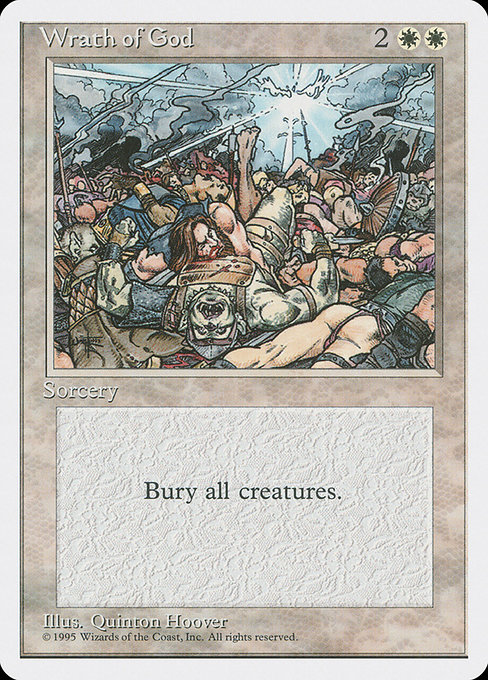
What it does
Wrath of God destroys all creatures and they cannot be regenerated — for four mana (two white and two generic) at sorcery speed. No exceptions, no targeting, no conditions. In a format where creature-based strategies frequently deploy three or four threats by turn three, Wrath of God resets the board and the game clock simultaneously. The “cannot be regenerated” clause prevents Regenerate abilities from saving creatures, which is occasionally relevant but rarely decisive in Premodern’s creature pool.
When it’s played
Wrath of God is the board-reset tool in white-based control strategies.
- Mono-White Control and Astral Slide both run Wrath as their primary creature sweep.
- GW Enchantress includes Wrath in the sideboard for creature-heavy matchups.
- Wake uses Wrath alongside Mirari’s Wake — Wrath resets the board, Wake’s mana doubling fuels the next Wrath.
- Replenish sometimes includes Wrath in the sideboard against aggressive strategies that threaten before Replenish can resolve.
The math / interaction worth knowing
Wrath of God destroys your own creatures too. All creatures means all creatures. The white-based control decks that run Wrath are built with few or no creatures of their own, so Wrath is one-sided in practice. Mishra’s Factory is a land until activated — activating Factory as a 2/2 before Wrath resolves means it will be destroyed. More importantly: Astral Slide uses Wrath alongside Lightning Rift — Slide protects your own creatures from Wrath by phasing them out with the Slide ability before Wrath resolves.
Wrath at sorcery speed means opponents develop one turn before you can reset. If the opponent plays three creatures on turns one through three, and you Wrath on turn four, you’ve taken three turns of attacks. Wrath stops future damage but not past damage. White control decks must account for this by running enough life gain or defensive creatures to survive to turn four.
The curve setup for Wrath. The typical control game plan: turns one and two, play disruption and mana development. Turn three, play Swords to Plowshares on the most threatening creature. Turn four, cast Wrath to clear the rest. This leaves you with four open mana on turn four, which means holding up Wrath and a one-mana removal spell is the “keep up to sweep” posture.
Wrath in a control shell often costs “losing” the turn. Wrath taps you out for four mana at sorcery speed. On the opponent’s next turn, you have no mana to hold up counters or removal. This vulnerability — going shields-down the turn after Wrath — is why many white control pilots include Counterspell backup or simply time Wrath for end-of-the-opponent’s-combat-step… which is not possible (Wrath is sorcery). Instead, the timing is your main phase, which means the turn after Wrath you start holding up counters again.
Decklists worth studying
When deck data populates, look for Astral Slide and Mono-White Control lists from MTGO Premodern Challenges. The Wrath count and the creatures (if any) in those lists reveal the pilot’s philosophy about board control versus proactive threats.
Related cards
- Swords to Plowshares — Single-target removal that precedes Wrath in the sequencing.
- Astral Slide — The enchantment that can protect creatures from Wrath by phasing them out.
- Lightning Rift — Co-played with Astral Slide; Rift deals damage, Slide provides protection from Wrath.
- Pernicious Deed — The green-black parallel; Deed scales but requires set-up.
- Counterspell — Held up alongside Wrath in blue-white builds for the shields-down turn.
- Decree of Justice — In post-Wrath turns, Decree creates an army to end the game.